
In-House QA vs. Outsourcing: How Growing Tech Companies Should Think About Testing
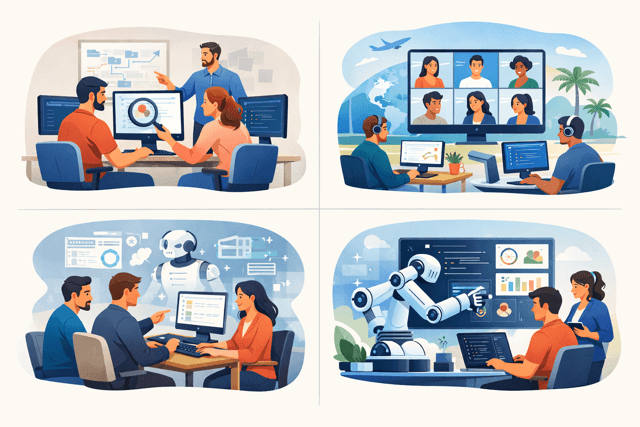
As engineering organizations scale, quality assurance becomes both more critical and more complex. Releases accelerate. Architectures sprawl. The surface area for defects expands faster than most teams expect.
At some point, every growing technology company runs into the same tension:
Should we build QA capacity in-house, outsource it, or assemble something in between?
This article breaks down the most common QA delivery models and explores their trade-offs.
Why QA Models Matter for Growing Tech Companies
It often starts with a release that takes longer than expected. Or a bug that slips to production and erodes customer trust. Or an engineering team that begins quietly working around QA because “they’re overloaded right now.”
At early stages, quality problems are survivable. Customers forgive rough edges. Engineers patch fast. But as growth compounds, those same shortcuts turn into drag:
Releases slow because regression testing becomes unpredictable
Engineers lose confidence in what’s safe to ship
QA becomes a bottleneck
Leadership starts asking why velocity and quality feel at odds
This is the moment where the QA model stops being an operational detail and becomes a strategic decision.
Choosing the right model shapes how your organization thinks about risk, ownership, and scale. By choosing the right model today, you avoid the pain of changing course down the road.
Model 1: Fully In-House QA Team
What It Looks Like
You hire dedicated QA engineers or testers as full-time employees embedded within product or engineering teams.
Pros
Deep product and domain knowledge
Tight collaboration with engineering and product
Strong ownership and accountability
Easier alignment with internal processes and culture
Cons
Fixed capacity: QA bandwidth does not scale with release spikes or roadmap shifts
Knowledge stagnation risk: Teams often reuse familiar tools and patterns long after better approaches exist
Recruiting, onboarding, and retention costs
Difficult to justify specialists (performance, security, accessibility) at smaller scales
With this model, strong QA leadership is essential. Without it, teams tend to over-invest in brittle automation or under-invest in risk-based testing. In-house QA works best for organizations with stable roadmaps, deep domain complexity, and the patience to build long-term testing maturity.
Model 2: QA as a Shared Responsibility
What It Looks Like
Testing is distributed across the team. For example, product managers validate workflows, engineers write tests, and designers review UX consistency.
Pros
Low incremental cost
Strong sense of shared ownership for quality
Effective for small, highly autonomous teams
Cons
QA is often deprioritized under delivery pressure
Inconsistent depth and coverage
Limited expertise in edge cases and non-functional testing
Does not scale well as systems and teams grow
AI tools can make this model more viable by assisting with test creation and validation, but they do not replace the need for QA strategy. This approach is common in early-stage companies, and often stay in place until quality issues force a rethink.
Model 3: Offshoring and Nearshoring
What It Looks Like
QA work is handled by teams in lower-cost regions, either directly or through a vendor. Nearshoring is an alternative that offers closer time zones and cultural alignment, but far less common in practice than offshoring.
Pros
Cost efficiency at scale
Access to large pools of testers
Ability to flex capacity up or down more easily than hiring full-time staff
Supports extended or near-continuous testing cycles
Cons
Communication and feedback loop delays
Potential gaps in product context or quality expectations
Requires strong documentation and process discipline
Risk of QA becoming execution-focused rather than insight-driven
While contract QA seems flexible, it is effective only when paired with disciplined management. Poorly defined engagements often balloon in size while delivering diminishing returns. This model works best for mature products with stable requirements and leaders experienced in managing distributed QA teams.
Model 4: AI QA Tools and Agents
What It Looks Like
There has been an explosion of AI-powered QA tools or agents to generate tests, maintain automation, or analyze coverage.
Pros
Faster test creation and maintenance
Potential to reduce manual regression effort
Scales more efficiently than human-only approaches
Cons
Requires careful evaluation and vendor selection
Implementation effort is often underestimated
Needs ongoing monitoring, tuning, and governance
This model is frequently oversold as autonomous QA. In reality, AI tools shift where effort is spent. Teams still need QA expertise to define workflows, evaluate results, and adapt strategies as systems evolve. Without that foundation, AI introduces false confidence rather than real coverage.
Model 5: AI-Enabled, Embedded QA Partnerships
What It Looks Like
Instead of buying tools or staffing testers in isolation, QA is delivered as an integrated system: experienced QA professionals embedded with your team, powered by AI, and accountable for outcomes, not just activity.
This model blends:
Strategic QA leadership
Flexible human expertise
AI-driven automation and optimization
Continuous adaptation as products evolve
Pros
Combines flexibility with deep product context
Scales capacity without fixed headcount
Leverages AI without requiring internal procurement or maintenance
Focuses on coverage, risk, and outcomes—not just test counts
Cons
Requires a high-trust partnership
Demands transparency and collaboration
Not interchangeable with low-cost vendors
This approach is still relatively rare—but it represents a “best of all worlds” model for scaling teams that want adaptability, affordability, and modern AI capabilities.
Tessana’s Unique Approach
At Tessana, we built our model around a simple belief: growing engineering teams should not have to choose between speed, quality, and flexibility. Our AI-enabled QA partnership delivers:
Comprehensive test coverage across manual, automated, and exploratory testing
White-glove service, with experienced QA professionals embedded in your workflows
Self-healing automation that adapts as your product changes
AI-driven prioritization to focus effort where risk actually lives
Instead of asking you to manage tools, vendors, or fluctuating capacity, we take ownership of end-to-end quality.
If your team is feeling the strain of scaling without confidence, the next step isn’t choosing in-house or outsourced QA. It’s choosing a model designed for how modern software is actually built.
Talk with our team to see how AI-enabled QA can evolve with your product, and deliver on the promise of higher software quality.

Lightning-Fast, White-Glove QA at a Fraction of the Cost
Don't wait until something breaks and your customers complain. Increase your test coverage now!
© Copyright 2025, All Rights Reserved by Tessana, Inc