
The Unhappy Path
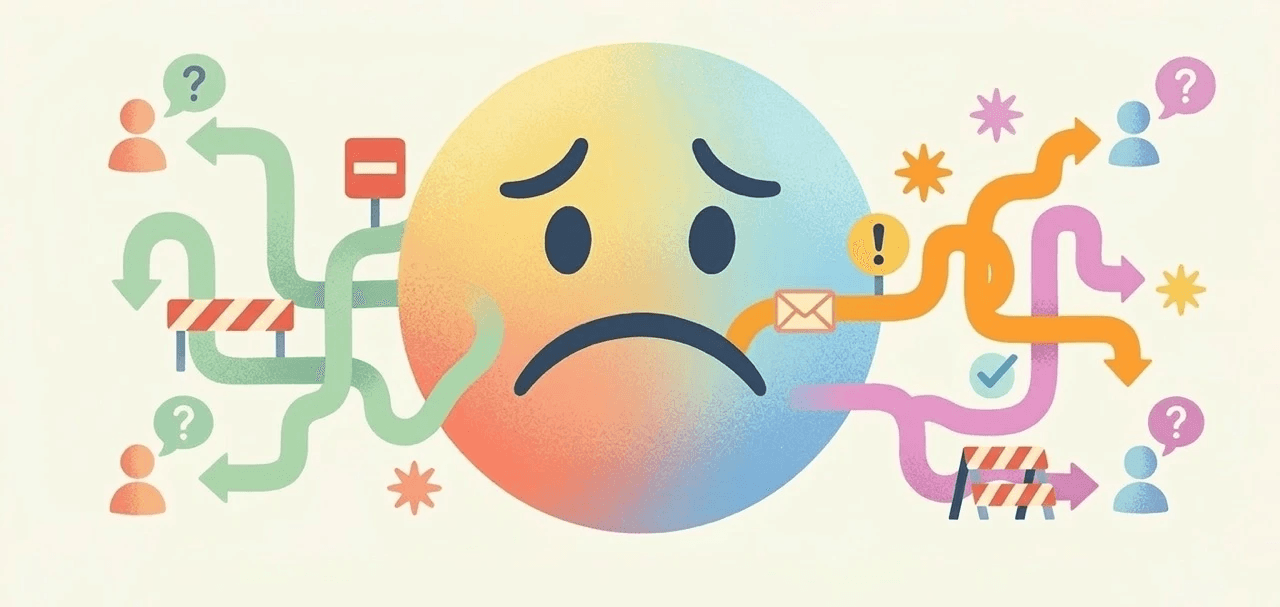
When product teams talk about user journeys, we often start with the happy path . We envision the smooth, ideal flow where everything works exactly as intended. A user signs up, logs in, completes a task, and leaves satisfied. No errors. No friction. No surprises.
But real users don’t live on the happy path.
The unhappy path includes everything that can go wrong: invalid inputs, flaky networks, expired sessions, edge cases, race conditions, confusing states, and unexpected behavior. It’s where assumptions break and complexity reveals itself.
Quality Assurance testing absolutely protects the happy path, ensuring core functionality works as designed. But the real value of QA emerges when we explore the unhappy path. That’s where resilience is built, trust is earned, and great products distinguish themselves.
And it’s also where testing quickly becomes much more difficult and structured thinking becomes absolutely essential.
Why the Unhappy Path Is So Hard to Create
The happy path is written in requirements. Inputs are valid. Dependencies respond. The environment cooperates.
The unhappy path is not a collection of edge cases, it requires imagination. There has to be a willingness to challenge assumptions that no one documented because it’s situations that shouldn’t happen.
Good QA doesn’t just ask, “Does it work?” It asks questions like:
What assumptions are we making?
What state does the system enter when something breaks?
Can a user recover?
Does the product preserve trust?
To explore this well, we can’t just rely on checklists. We need structured thinking.
A Structured Approach to Chaos Thinking
Structured chaos thinking means intentionally disrupting assumptions — one variable at a time — and observing behavior under stress.
1. Surface the Assumptions
Every feature relies on invisible agreements:
The network is stable.
The database write succeeds.
The response returns quickly.
The user submits once.
The session remains valid.
Data remains consistent between systems.
Write these down. Many teams have never articulated these assumptions. But once named, they become testable.
Surface these assumptions early. Each assumption becomes an opportunity to enter the unhappy path.
2. Break One Variable at a Time
Instead of imagining a catastrophic failure, introduce controlled instability:
Delay a response.
Drop a request.
Submit malformed input.
Trigger duplicate submissions.
Interrupt a flow midway.
Expire a session during a critical action.
The complexity of testing increases when it evolves from validating steps to examining interactions between components, but the value of QA dramatically increases.
3. Follow the State, Not Just the Error
Many teams stop at: “An error appears.”
The more important question is: What state is the system now in?
Is data partially persisted?
Can the user retry safely?
Will a background job reconcile inconsistencies?
Does refreshing the page make things worse?
When QA expands into system-level thinking the work stops being about features and starts being about behavior under stress.
Progressive Layering: How to Ask “What If?” Repeatedly
Asking “What if?” once is easy, but the key is progressive layering.
Layer 1: Inputs
What if the data is invalid?
What if required fields are missing?
What if values are just at the boundary?
Layer 2: Timing
What if the user clicks twice?
What if they navigate away mid-request?
What if two users act at the same time?
Layer 3: Environment
What if the network drops?
What if a dependency times out?
What if a downstream service returns stale data?
Layer 4: State and Recovery
What if part of the operation succeeded?
What if a retry occurs after a partial save?
What if the system restarts mid-process?
Can the user safely recover?
This final layer forces teams to confront how failure behaves, not just whether it’s detected. We then graduate from the impossible task of preventing every failure to shaping how failure behaves.
Each new “what if” should do one of three things:
Break an assumption.
Alter system state.
Force a recovery decision.
Staying in Control when Navigating the Unhappy Path
Because the unhappy path is inherently complex, it can easily become unbounded.
A structured approach keeps it intentional:
Clearly map the happy path.
Identify critical state transitions (writes, permissions, cross-service calls).
Apply progressive disruption at those points.
Evaluate recovery — not just error detection.
Over time, QA stops being the function that finds obvious defects and becomes the team that exposes systemic risk and builds resilience
The Real Value of the Unhappy Path
Testing the happy path proves functionality. Products that only work when conditions are ideal may pass demos. Products that behave predictably when things go wrong earn trust.
Testing the unhappy path proves durability. And durability is what users actually experience in the real world.
The unhappy path is difficult because it requires imagination, systems thinking, and comfort with uncertainty. It demands that teams confront complexity instead of assuming it away.
But that difficulty is the point. That is the craft of testing the unhappy path.

Lightning-Fast, White-Glove QA at a Fraction of the Cost
Don't wait until something breaks and your customers complain. Increase your test coverage now!
© Copyright 2025, All Rights Reserved by Tessana, Inc